|
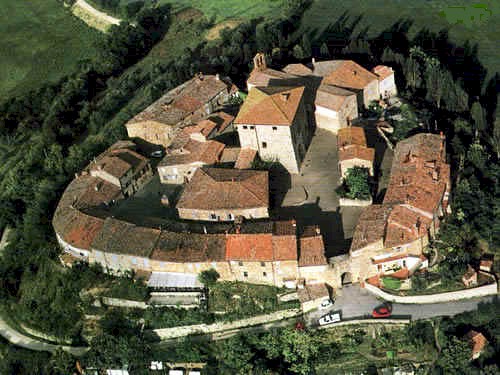
Murlo is a formerly castellated village located on a densely forested
hill that dominates the valley of the Crevole, SW of Sienna, on the border
between the Val di Merse, to which it belongs, and the Crete Senesi
area of Val d’Arbia. Murlo looks out onto the valley of the Ombrone and
Montalcino.
Murlo is possibly of Etruscan origin since Etruscan artifacts and remains
have been uncovered at nearby Poggio Civitate and Poggio Aguzzo.
There is evidence that the current human population harbours genes in common
with ancient Etruscan DNA suggesting a high degree of isolation over the
past two thousand years.
The castle of Murlo dates to the 12 C when it was the main centre of the Fief
of the Bishops of Sienna. The layout as seen today is a result of
reconstruction carried out at the end of the 16 C after the fall of the
Siennese Republic to the Florentines. The castle walls have been converted
into small dwellings surrounding the Bishop’s Palace, which today houses the Archaeological
Museum, and the cathedral. There are two access gates to the castle.
Construction of houses making use of outer castle walls is a quite common
feature of Tuscan vernacular architecture - see for example Castello di Tocchi. Montefioralle,
Tignano
and Vertine
in Chianti provide two further good examples.
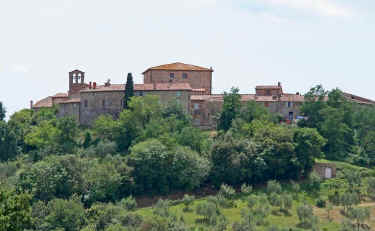
Murlo
on its hilltop
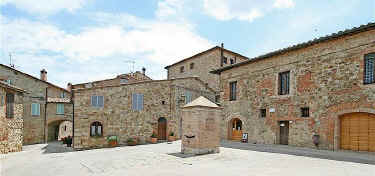
Piazza of Murlo
Murlo forms an excellent home base for tourists planning to visit
important historical and artistic centres in Tuscany.
Sienna can be reached in only 20 minutes by car, Florence or the coast in
roughly an hour,
and Montalcino,
Pienza, Sant'Antimo
and San Galgano in 30 minutes.
Arches
in Murlo
The
village of Vescovado is near Murlo and was formed by the merger of
the two villages of Andica and Tinoni which were still separate at the beginning of the
19 C. The church in Vescovado houses a 1475 painting by Benvenuto di Giovanni depicting the Virgin Enthroned with Saints.
Eremo di Montespecchio Montepescini -
the Ruined Hermitage of Montespecchio
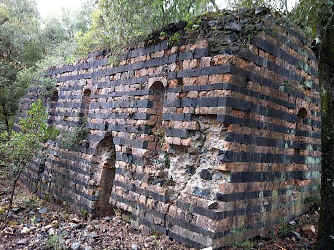
The hermitage of Montespecchio is a place of great beauty, despite being reduced to little more than a ruin. The remains of the building
are located in dense forest near Murlo. The alternation in colours
between the dark green Vallerano marble and valuable pink marble are
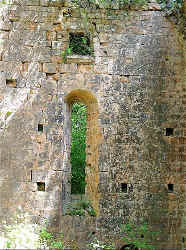
still vivid even today. One can see the remains of part of the perimeter walls interrupted by thin,
arched lancet windows and the collapsed barrel vault with traces of the pilasters and capitals that supported the arch of the nave.
The Eremo was one of the largest Augustinian structures of its time and
its construction dates back to the 13 C. In 1449, one of the final
stages of the definition of Augustinian observance took place here. By the
17 C, the precarious condition of the building forced the last of the religious to
move and it eventually fell into ruin.
 |
 |
|
Ruins of the
Hermitage of Montespecchio |
|
)
)
)
)
)
)